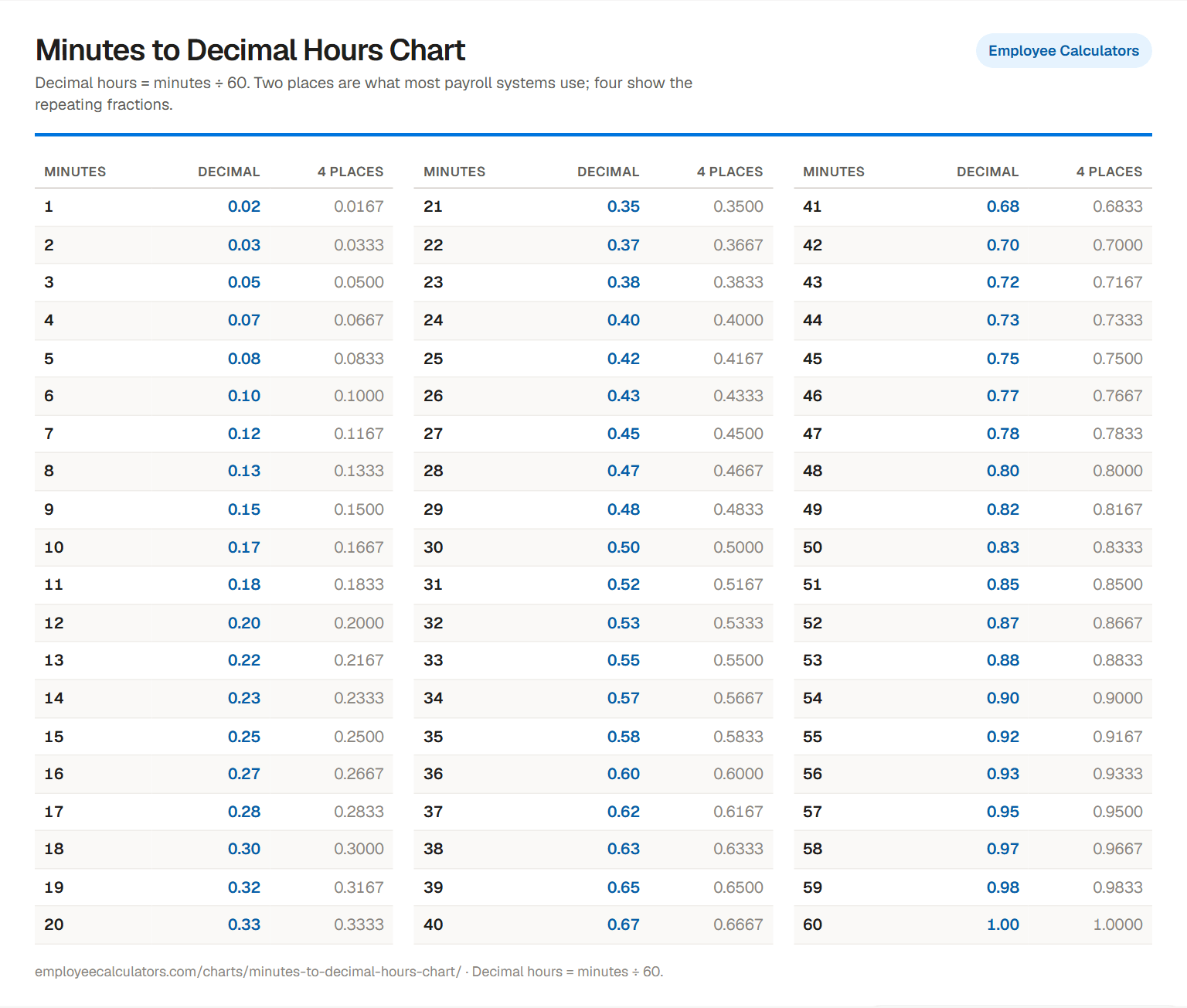
How to read the chart
Find the minutes in the left column and read the decimal across. For 7 hours 45 minutes, 45 minutes is 0.75, so the time card shows 7.75 hours. Multiply that by the hourly rate: 7.75 × $20 = $155.
Keep the whole hours as they are and convert only the minutes. A full week of 38 hours 50 minutes is 38 + 0.83 = 38.83 decimal hours.
The most common mistake
7.30 on a timesheet is not 7 hours 30 minutes. 7 hours 30 minutes is 7.50 decimal hours, and 7.30 decimal hours is 7 hours 18 minutes. Writing minutes after the decimal point underpays 30 minutes as 18.
Two places or four?
Some minutes repeat forever: 20 minutes is 0.3333… hours. Rounding to two places (0.33) can move pay by a fraction of a cent per hour, which adds up over a long week. The four-place column shows the more exact value. Your employer's payroll system decides which one is used; time clock rounding rules are a separate question covered in how to calculate a time card.
Related tools and guides
For any value that is not on the chart, use the decimal hours calculator. The guide explains the math step by step.
How this chart was made. Every value is computed by the same tested formulas as our calculators; nothing is typed by hand. Read our methodology and disclaimer.
Last updated: